How Casinos’ Public Image Changed Across Local Histories
Explore how casino public image took shape through local rules, customs, and civic debate, and see how to trace a venue’s distinct social history.
The common mistake in tracing casino public image is to treat every venue as part of one march from hidden gambling room to polished attraction. That story can make a local history sound settled when the available records may reveal competing accounts, uneven access, and changing rules instead.
Local records reveal how access was defined
To understand a particular venue, start with its place and period rather than assuming that the word “casino” meant the same thing everywhere. The label might refer to a private club, a public gaming room, or a larger leisure business; its meaning depended on local usage and law.
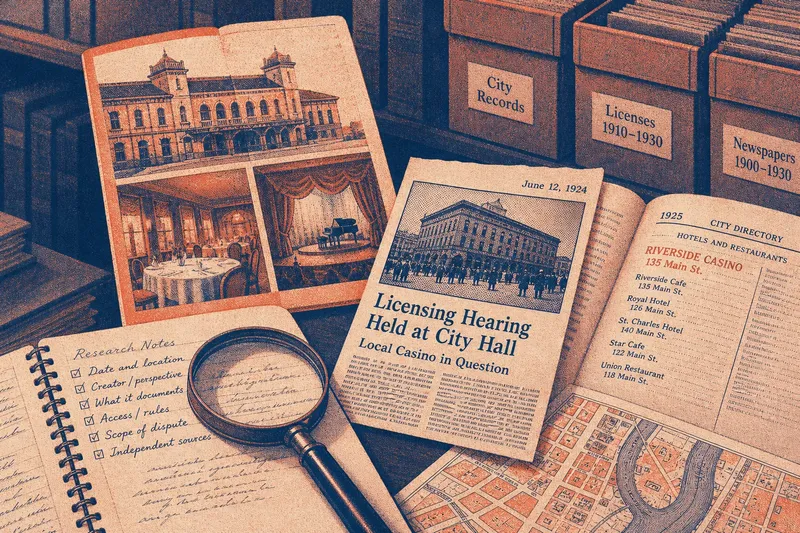
Look for records that show how people encountered the place: licensing documents, city directories, newspaper advertisements, meeting minutes, maps, and oral histories held by a local archive or historical society. These sources answer different questions. A license can document what authorities permitted, while an advertisement shows how a business sought to present itself.
Membership rules, invitations, dress expectations, and neighborhood customs can also illuminate access. A boundary did not always require a locked door. But unless a source documents a particular rule or custom, treat it as a question to investigate, not a fact to assume.
Publicity and civic debate tell different stories
A venue’s advertisements may emphasize dining, performances, lodging, or social events alongside gambling. Those details can help explain the image it wished to project, but they do not establish how residents understood it, who used it, or how much attention its gaming drew.
For that, compare the promotional record with local reporting, public meeting records, regulations, and accounts from people who lived nearby. Keep each source’s scope clear: a newspaper story about a licensing dispute documents that dispute, not a unanimous community view. A brochure documents the attractions it names, not the full experience of visitors.
This approach makes local history more than a fact-check on a venue’s self-description. It asks how public image was negotiated: who could enter, which activities officials regulated, what neighbors debated, and which descriptions became visible in the local record. The answers may differ across neighborhoods and over time.
How can you trace a casino’s local history?
Which records should you look for?
Begin with local newspapers, city directories, licensing records, maps, and archives. Check the date and place attached to each item so details from one era are not mistaken for another.
How can you tell a venue’s publicity from evidence of local opinion?
Identify who produced the material and what it was made to do. An advertisement records a public appeal; evidence of public opinion calls for distinct sources, such as attributed interviews, letters, or documented public meetings.
What if the sources disagree?
Record the disagreement rather than forcing a single account. A business notice and a critical news report may describe different aspects of the same place, so compare their dates, purposes, and specific claims.
A source checklist keeps local claims in bounds
- Check the date and location. If both are clear, use the source for that setting and period; if either is missing, seek a dated local record before making a historical claim.
- Check who created the source. If it comes from the venue, use it to describe the venue’s own presentation; if it comes from a reporter, official, or resident, identify that perspective rather than treating it as everyone’s view.
- Check what the source directly documents. If it names an activity or rule, report that specific detail; if it merely hints at one, look for corroboration or leave the point open.
- Check whether the record describes access. If it names membership terms, admission rules, or restrictions, use those details to discuss access; if it says nothing about entry, do not infer who could attend.
- Check the scope of a public dispute. If minutes or reporting identify particular speakers, describe their stated positions; if the record does not show broader participation, avoid calling the dispute a community consensus.
- Check for independent sources. If another dated local record supports the same detail, explain how the sources complement each other; if accounts conflict, preserve the difference and investigate their purposes.
A fictional archive search shows how to limit a claim
Say you are tracing a fictional venue in a fictional town. Your starting materials are one undated brochure naming a dining room and stage, a newspaper clipping dated 1924 that reports a licensing hearing, and a city directory dated 1925 that lists the business at a downtown address.
First, use the directory to establish that the business appeared at that address in 1925; do not use it to infer what happened there. Next, use the clipping to say that a licensing hearing was reported in 1924; unless it quotes or identifies wider participation, do not call the report a town-wide debate. Then treat the brochure’s dining room and stage as claims about how the venue presented itself, not proof that those facilities operated in 1924 or 1925. The resulting account is precise but limited: the directory places the fictional business downtown in 1925, the clipping records a reported hearing the year before, and the undated brochure promotes dining and performance. The gap between those records is a reason to search for more evidence, not a license to fill in a story.
Local context changes what a public image can mean
Casino public image is best traced through the records and disputes of a particular place, not through a universal progression from private to public. Local laws, access customs, business choices, and civic debate may each shape the account, but they should be connected only where the evidence supports the link.
When you describe a venue’s past, name the place and period, identify what each source can establish, and leave unresolved questions visible. That small discipline gives readers a more useful history than a broad label can—and shows where the next archival question belongs.