The Hot-Streak Story: Why a Run of Results Proves Nothing About the Next One
A hot streak does not predict the next result. Learn how to distinguish a memorable run from a real change in the game’s mechanism before deciding to play.
The common mistake after a run of wins is treating the next play as more promising; after a run of losses, it is assuming a win is due. A hot streak can describe what just happened, but it does not by itself explain what comes next. The useful question is not whether the run looks striking, but whether the game’s mechanism has changed.
A hot streak is a record, not a mechanism
Several wins, repeated roulette colors, or a string of favorable draws make a noticeable sequence. They are observations about earlier results. To use them as a forecast, you would need a reason those results affect the next one.
With independent outcomes, earlier results do not alter the next result’s chances. A roulette wheel does not remember its previous spins, and a properly randomized digital game does not become ready to reverse direction after a run of losses. The streak may continue or stop; its appearance alone does not decide which.
That distinction keeps the focus on the game itself. “Black appeared several times” reports a sequence. “Black is more likely now” makes a separate claim that needs a mechanism, not just a memorable run.
Check whether the game mechanism carries information forward
Not every game has independent outcomes. In a card game dealt from a finite shoe, cards already dealt are no longer available in that shoe. The remaining composition can therefore affect later draws. That effect comes from the cards that remain, not from a streak being due to continue or reverse.
Look at the rules and procedure: Is the deck reshuffled between rounds? Does the game use a finite set of pieces or a resettable random process? Has the setup changed? These details can matter more than the sequence’s surface pattern. If the mechanism is unclear, consult the stated rules or ask the venue instead of guessing from the last few results.
A wheel spin, a draw from a deck, a dice roll, and a digital game can rely on different processes. The right conclusion depends on those processes. Avoid carrying an assumption from one game into another just because both produce a sequence of wins and losses.
Short runs can look like patterns
Random sequences need not alternate neatly. Similar outcomes can cluster, while other stretches look balanced. A small slice of results can seem unusually orderly or lopsided without offering a dependable clue about what follows.
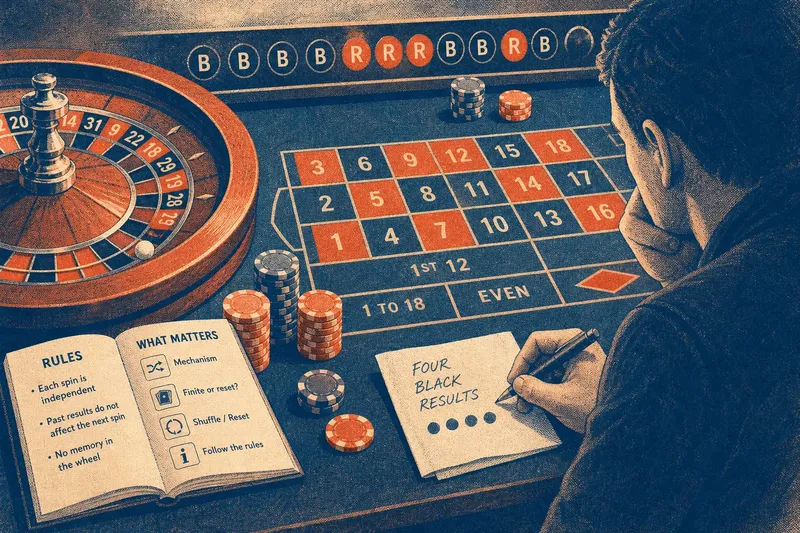
Imagine you sit at a roulette table and see black appear four times in a row; those numbers are invented to make the situation concrete, not a claim about a real session. You write “four black results” on a napkin, then ask whether the wheel’s rules give those earlier spins a bearing on the next one. If the answer is no, you have a record of the run, not a reason to favor red or black.
The same caution applies to an apparent winning streak. A run can feel like evidence of momentum, but the feeling does not establish that a person, machine, or game has acquired a lasting advantage. Look for a change in the process before assigning the sequence predictive meaning.
Separate a streak from the stories we attach to it
The gambler’s fallacy is the belief that an outcome becomes more likely simply because it has not appeared recently. Someone may see several losses and think a win is overdue, or expect black to appear because red has shown up repeatedly. For independent events, the sequence does not create a debt that the game must repay.
The opposite story is that recent success must continue. Skill or changing conditions can matter in some activities, but a streak alone does not establish either. Ask what specific feature could carry an effect forward; if the only answer is “the last results,” the sequence has not supplied that feature.
Selective memory can strengthen both stories. A run that continued is easy to recall, while one that ended quickly may fade into the background. A vivid recollection is not a complete record, and a complete record still does not predict an independent next result.
Use the rules to decide what the sequence can tell you
- Check whether the rules say each result is independent; if they do, treat the streak as history and choose without expecting it to alter the next outcome, but if they do not, identify the stated mechanism first.
- Check whether a finite deck or set of pieces is still in use; if earlier items are removed, consider only the remaining possibilities allowed by the rules, but if the set has been reset, do not treat removed items as unavailable.
- Check whether a shuffle, reset, or new round has changed the setup; if it has, base your understanding on the new procedure, but if it has not, do not invent a change from the streak alone.
- Check whether a display or announcement reports only recent results; if it does, read it as a record, but if it claims a predictive effect, look for a clear explanation in the game rules before relying on it.
- Check whether your reason for choosing a bet is only that a result is “due”; if it is, pause and reconsider without that assumption, but if another rule-based reason remains, assess that reason separately.
- Check whether recent wins make you want to keep playing or losses make you want to recover money; if either reaction is driving the decision, step away or follow the limit you set in advance, but do not let the streak rewrite that limit.
Say you arrive at a table where a finite shoe contains ten cards in the dealer’s stated setup, and you are told that two cards have already been dealt. These are invented quantities for illustration, not claims about a particular game. You first check the rules to confirm that dealt cards are not returned before the next draw; then you note that eight cards remain in the hypothetical shoe. You ask whether the identities of those two cards are known: if they are, the available possibilities are narrower in a specific way; if not, you cannot infer the exact remaining composition from the count alone. The practical result is a clearer description of what is known—and a decision not to treat a recent run as an extra signal.
Keep the game’s terms apart from a short run
A streak describes a short sequence. The house edge, where applicable, describes the mathematical advantage built into a game’s terms over repeated play. It does not tell you what the next individual result will be, and a lucky stretch does not rewrite the rules.
Read the rules or paytable to understand possible outcomes and payouts, not to search for a schedule of when a particular result will arrive. If you choose to play, decide what you are comfortable spending before the excitement of a run takes over. A win need not go back into play, and a loss does not need to be chased.
What should you ask before treating a streak as a signal?
Does the game use independent outcomes?
Check the game’s stated mechanism, not just its recent sequence. A wheel spin and a draw from a finite deck may differ because dealt cards can change what remains available.
Did the setup change between results?
A shuffle, reset, or new procedure may alter the possibilities if the rules say so. A streak by itself is not evidence that any such change occurred.
Am I reacting to a run because it feels dramatic?
Ask whether you would remember the sequence as clearly if it had ended sooner. If its drama is the main reason it seems predictive, treat that feeling as a prompt to pause rather than as evidence.
Would I make the same choice without the streak?
If not, name what the sequence has added besides excitement. For an independent outcome, the run itself does not improve the case for a bet.
Make choices without assigning the streak a job it cannot do
Name the observation and the interpretation separately: “These results happened” is an observation; “the next one is more likely” is a prediction. Then check whether the rules provide a real mechanism connecting them. If no such mechanism applies, the streak remains a description of the past.
For a game of chance, make any decision using the stated rules, your understanding of the possible outcomes, and the limits you set for yourself. A hot streak may continue or end, but it cannot tell you which. When a game uses a finite set of items, focus on what the rules say remains available; that is a more useful question than asking what the sequence seems to owe you.